Javier Mendoza  /  The Animals  /  Ocean
Reptiles · Ocean

American Crocodile

Crocodylus acutus

Unlike the alligator it is often mistaken for, the American crocodile is a creature of salt water, at home on mangrove coasts and coral atolls from Florida to Peru.

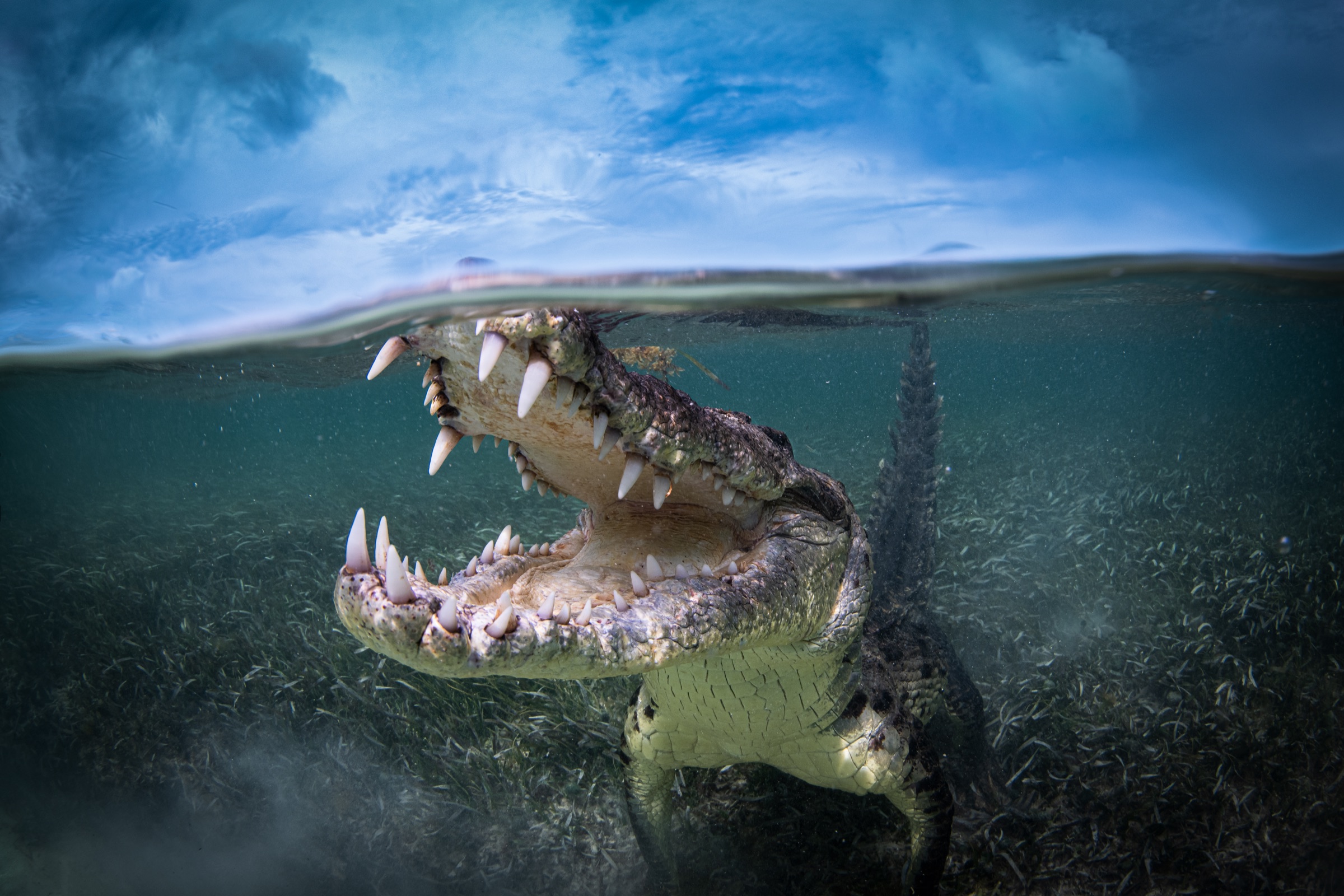
A split-level photograph of an American crocodile at the waterline, jaws wide open showing its teeth, seagrass below and blue sky above.
The Crocodile · Mexico · © Javier MendozaOrder this print
Up to ~15 ft
Large males; most adults are 10 to 13 ft
Florida Fish and Wildlife Conservation Commission
Salt glands
On the tongue, which let it live in the sea
National Geographic
~2,000
In Florida today, from a few hundred in 1975
FWC
Vulnerable
IUCN Red List; recovering in Florida, pressured elsewhere
IUCN

Ancient and unhurried

The American crocodile is greyer and narrower-snouted than the alligator, with a lower fourth tooth that shows when the mouth is closed. It ranges along Caribbean and Pacific coasts from south Florida and Mexico to northern South America, in lagoons, mangrove channels and, on Mexico's reef atolls, over clear seagrass flats in water as transparent as glass.

It feeds mostly on fish and crabs and is far less aggressive toward people than the Nile or saltwater crocodile; the shyness is part of why the species survived the skin trade.

Status

The IUCN lists the species as Vulnerable. Florida's population has grown from a few hundred animals when it was listed as endangered in 1975 to around two thousand, and in 2007 it was downgraded to threatened there, a slow success story. Elsewhere, coastal development and nest disturbance keep it at risk.

In the collection

1 frame · prints from 12″ to 40″+
A split-level photograph of an American crocodile at the waterline, jaws wide open showing its teeth, seagrass below and blue sky above.
The CrocodileMexico

Half above, half below — an American crocodile opens its jaws at the waterline over the seagrass flats, ancient and unhurried in water clear as glass.

View & order this print →
Own the photograph
Museum-quality prints from 16-bit masters — metal, canvas or archival fine-art paper, printed in the USA.
Order a print

Questions people ask

What is the difference between an American crocodile and an alligator?

Crocodiles are greyish with a narrower, V-shaped snout and a visible lower tooth when the mouth is closed; alligators are darker with a broad, U-shaped snout. Crocodiles tolerate salt water; alligators mostly stay in fresh.

How big do American crocodiles get?

Most adults are 10 to 13 feet long; large males can reach about 15 feet.

Are American crocodiles dangerous?

They are shy compared with other large crocodilians and attacks on people are rare, but any crocodile of this size deserves distance and respect.

Sources
  1. IUCN Red List, Crocodylus acutus
  2. Florida Fish and Wildlife Conservation Commission: American crocodile
  3. National Geographic: American crocodile
  4. U.S. Fish and Wildlife Service: 2007 reclassification of the Florida population to threatened
More animals
Great White SharkThe ocean's most storied predator Shortfin Mako SharkThe fastest shark in the world Blue SharkThe most fished shark on Earth Bull SharkThe shark that swims up rivers All 17 animalsLand & ocean